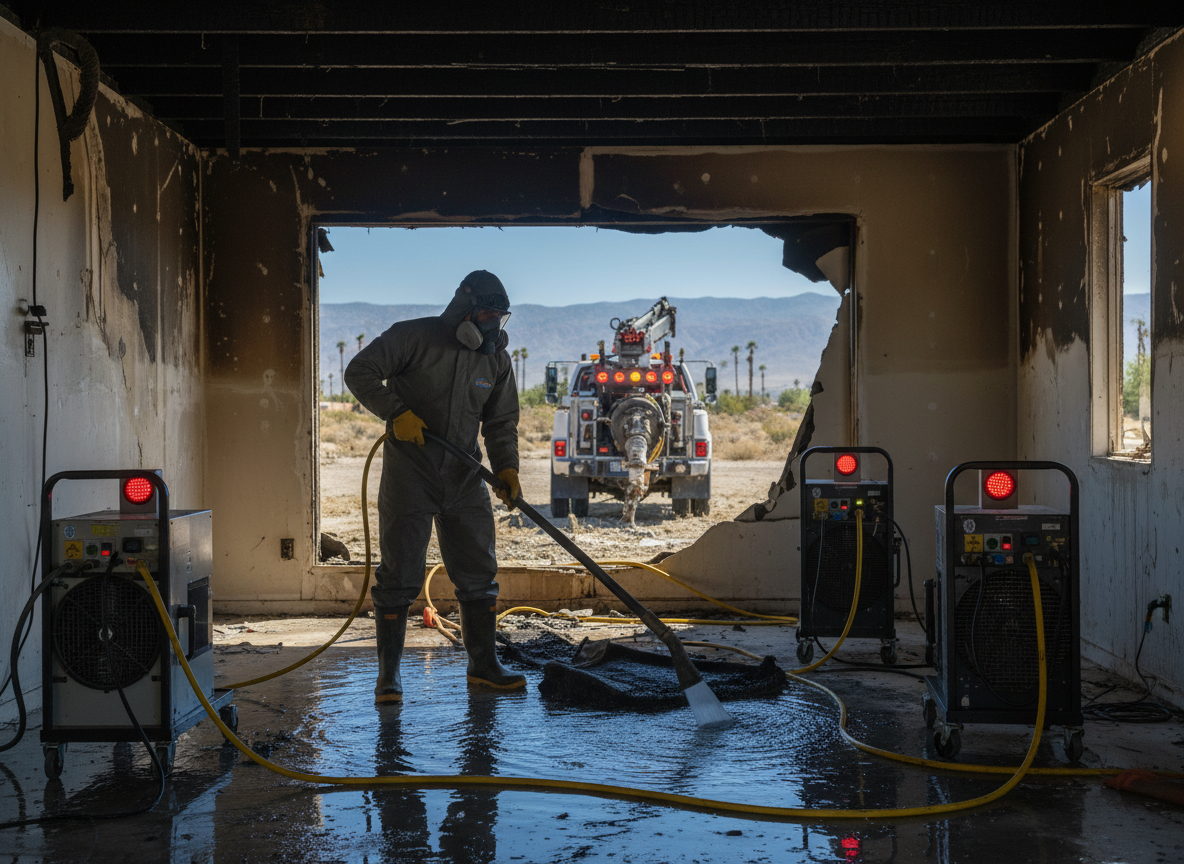
In North Palm Springs, homes built on the alluvial fans near Indian Avenue often feature stucco exteriors and flat roofs that trap firefighting water between layers. When a structure fire is suppressed, the high-volume water quickly saturates drywall, insulation and subfloors. The region’s low humidity and extreme summer heat then drive rapid evaporation, leaving behind concentrated mineral deposits and embedded soot that standard cleaning misses. Technicians must remove baseboards and drill weep holes in exterior walls to prevent hidden mold growth that appears weeks later during the mild winter rains.
Riverside County code requires proper disposal of contaminated drywall and carpet padding after any fire-related water event. Crews separate these materials from regular construction debris because soot contains heavy metals from burned wiring and furnishings common in 1970s–1990s desert tract homes. Negative-air machines with HEPA filtration run continuously to capture airborne particles before they settle into neighboring units in multi-family properties along North Indian Avenue. Failure to contain the plume can force additional remediation in adjacent homes when the desert wind picks up.
Desert Hot Springs and Palm Springs properties nearby share the same granitic soil that drains poorly once compacted by heavy equipment. After water extraction, crews place commercial dehumidifiers and air movers in a grid pattern, checking moisture readings every four hours until drywall and framing drop below 12 percent. Skipping this step leaves salts that wick moisture from the air during the next monsoon season, restarting the cycle of hidden damage.
Technician insight
In North Palm Springs, the thing that catches most people out with water damage remediation after fire is how fast the desert heat bakes firefighting water into the stucco and slab edges along Indian Avenue. Homeowners think once the puddles are gone the job is finished, but the mineral crust left behind pulls new moisture from the air during winter and restarts hidden rot in older tract homes.
Firefighting Water in a North Palm Springs Stucco Home
A kitchen fire in a 1980s home near 19997 N Indian Ave sent water through the ceiling into the attic. We found standing water trapped above the drywall and soot drawn into the return ducts. Extraction and targeted drying prevented mold from forming before the next seasonal rain, and the owner reopened the house within ten days.
How it works
- 1
Emergency Assessment
Arrive on site, identify all water paths from firefighting efforts, and document soot migration through HVAC systems common in North Palm Springs homes.
- 2
Water Extraction and Containment
Remove standing water with truck-mounted units while sealing affected rooms to prevent soot cross-contamination to unaffected areas.
- 3
Drying and Monitoring
Place drying equipment and track moisture levels in stucco walls and concrete slabs until readings meet industry standards for the local climate.
- 4
Soot and Residue Removal
Clean surfaces with appropriate agents, remove contaminated porous materials, and verify clearance before reconstruction begins.
Pricing
Pricing varies by affected square footage, depth of soot penetration, and whether HVAC systems require separate cleaning.