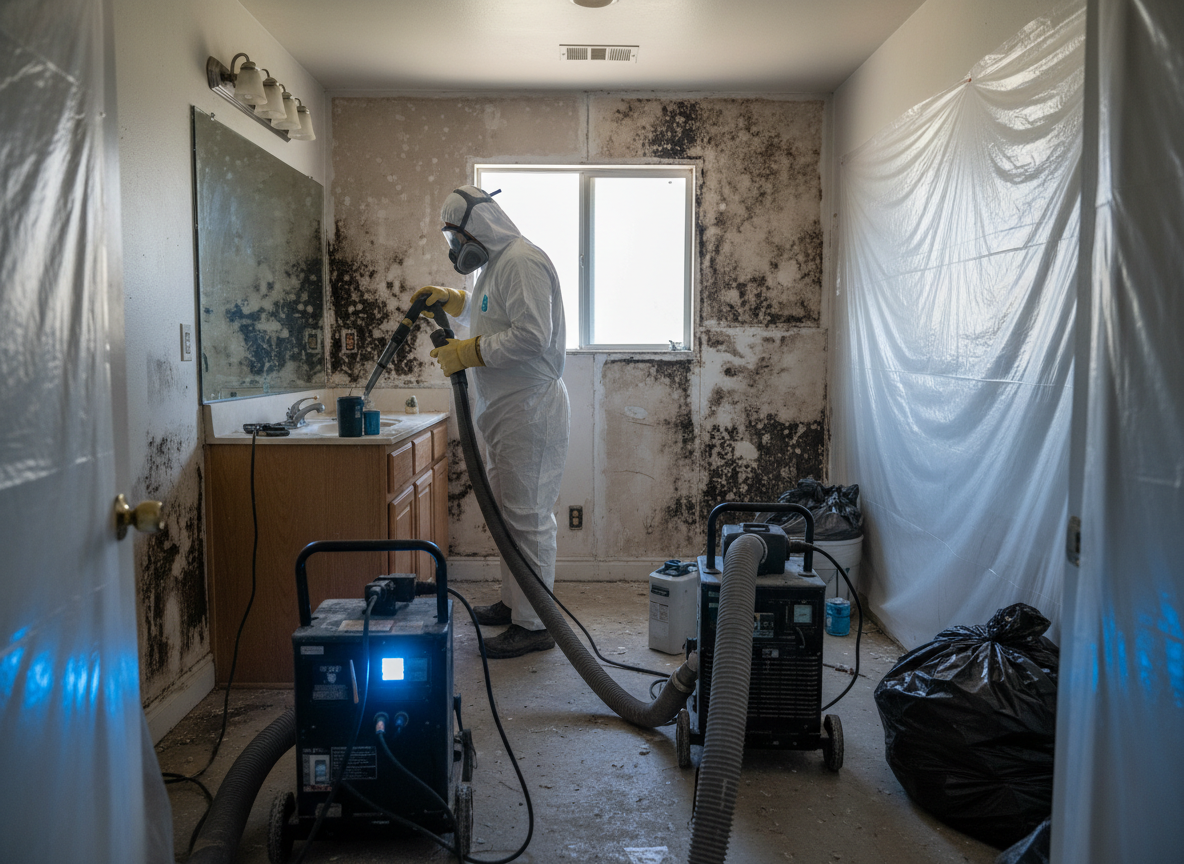
North Palm Springs sits in Riverside County where hot desert summers push indoor humidity spikes from air conditioning units and occasional monsoon runoff. Older single-story homes near Indian Avenue often have slab foundations and stucco exteriors that trap moisture after a pipe burst or roof leak. When water sits even a few days, mold colonies form behind baseboards and in HVAC ducts. Remediation starts with moisture mapping using thermal cameras to locate hidden pockets that standard fans miss, followed by HEPA air scrubbing and antimicrobial treatment on affected framing. Desert heat accelerates spore spread once disturbed, so containment barriers must stay sealed until clearance testing confirms levels below 1,000 spores per cubic meter.
Homeowners in North Palm Springs and nearby Desert Hot Springs frequently discover mold after monsoon season when poorly graded yards direct water toward foundations. We remove saturated drywall up to 18 inches above the water line, discard porous materials like carpet padding, and apply borate solutions to joists. Because summers here routinely exceed 110 degrees, drying equipment must be calibrated to avoid warping remaining wood while still pulling moisture below 15 percent. Skipping the final air quality test leaves residents with lingering musty odors that travel through shared wall cavities common in 1970s tract housing.
Flash flooding along washes near Palm Springs can push water under mobile homes and older ranch houses in North Palm Springs. In these cases we excavate soil along the stem wall, treat the crawl space if present, and install temporary dehumidification units sized for the square footage. Local building practices often leave minimal ventilation under homes, so we add passive vents during restoration to reduce future risk. Every job ends with documentation photos and a written scope so insurance adjusters see exactly what was removed and treated.
Technician insight
In North Palm Springs the thing that catches most people out with mold remediation after water damage is how fast spores travel through the shared stucco walls and attic spaces of 1970s homes once you start cutting drywall. The desert heat dries the surface fast but leaves moisture trapped against the slab, so you have to pull base plates and check under cabinets or the job fails clearance.
Monsoon leak behind kitchen cabinets
Water from a roof valley entered during a summer storm and wicked into the drywall under the sink. We found elevated moisture in the toe-kick and along the slab edge. After removing the lower cabinets and treating the framing, we ran targeted drying for four days and passed air sampling with no detectable mold in adjacent rooms.
How it works
- 1
Initial Assessment
Technician arrives within hours, maps moisture with infrared and pin meters, and identifies affected materials in walls, ceilings, or under slabs.
- 2
Containment Setup
Plastic barriers and negative air machines isolate the work zone to prevent spore migration into clean areas of the home.
- 3
Removal and Treatment
Saturated drywall, insulation, and trim are cut out; remaining surfaces receive EPA-registered antimicrobials and HEPA vacuuming.
- 4
Drying and Clearance
Commercial air movers and dehumidifiers run until moisture readings stabilize, followed by independent air sampling before barriers come down.
Pricing
Cost depends on square footage affected, depth of hidden moisture, and whether HVAC ducts require cleaning.